


Single-Carbon-Nanotube Field-Effect Transistors: Fluidics-Integrated Arrays from Dispersed CVD Growths
J.-N. Deraspe, C.M. Bazán, D. Bouilly, Single-Carbon-Nanotube Field-Effect Transistors: Fluidics-Integrated Arrays from Dispersed CVD Growths, ChemRxiv, 2026
Abstract
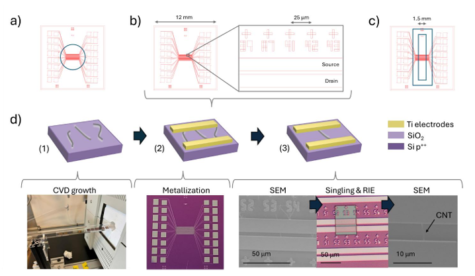
Single-carbon-nanotube field-effect transistors (1-CNTFETs) offer a unique capability for single-molecule experiments, enabling real-time tracking of localized chemical and biomolecular interactions on the surface of the nanotube with exceptional temporal resolution and dynamic range. To properly capture the inherent stochasticity of single-molecule reactions, such experiments require large numbers of devices, each based around a single, electrically clean nanotube embedded in a fluidic environment, which still represents a technical challenge. Here, we report a fabrication strategy based on randomly dispersed carbon nanotubes (CNTs) grown by chemical vapor deposition (CVD), in which the surface density and electrode design are co-optimized to maximize the probability of CNT interception, the feasibility of singling an isolated CNT and the operation of the device array in fluidics. This process results in an average device yield >70%, limited primarily by the selection of CNT with excellent conductivity and contacts, rather than by the interception or singling processes. These results position 1-CNTFETs as a more accessible platform for the exploration of chemical and biological mechanisms at the single-molecule level.
This content has been updated on 14 March 2026 at 15h44.